Spelling & sound
Silent letters: keep the spelling, lose the extra sound
Practise kn-, wr- and final -mb with whole-word examples, clear endings and a routine for spelling traps.
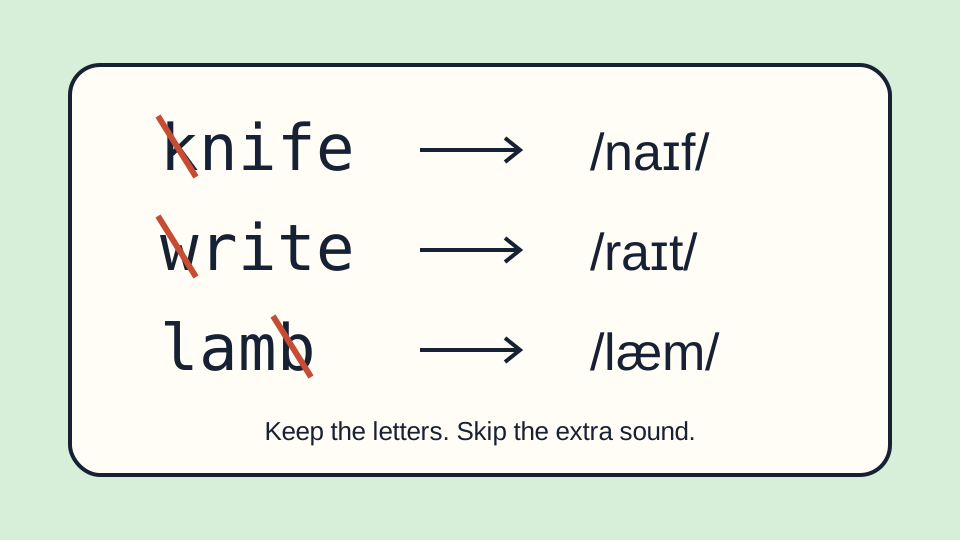
The idea in a minute
A silent letter stays in spelling without receiving its own sound in a particular word. Knife begins with /n/, not /kn/. Lamb ends in /m/, not /mb/. Learning these patterns reduces the temptation to pronounce every visible letter. Patterns are a starting point; pronunciation can change in related words, so check the word you actually need.
What your mouth is doing
Begin knife with the tongue at the ridge behind your upper teeth for /n/, letting sound resonate through the nose. Do not make a /k/ closure at the back of the tongue first. End lamb with both lips closed for /m/ and nasal airflow. Do not open into a new vowel after the final consonant. The silence is an absence, not a pause you must insert.
Connect it to your first language
In Mandarin, many consonants are learned through syllable names that include a vowel; carry only the consonant movement into an English word. Spanish h is a familiar silent-letter example, but do not transfer that rule to all English h words: hat begins with /h/, while honest does not. Each spelling system has its own history and exceptions.
Try this practice sequence
- Group knife and knee under kn-. Listen and say the words from /n/. Keep the written k visible but cross it out as a personal reminder.
- Group write and wrong under wr-. Begin with /r/ directly. Do not round into a separate /w/ sound first.
- Compare lamb, thumb and climb. Finish at /m/, then pause. Notice that your lips are already closed; no additional /b/ release is needed.
- Test one unfamiliar word, such as debt. Predict, check the dictionary, then write an exception note. Practise it in a meaningful phrase rather than building a long silent-letter list.
Common traps
Do not delete the silent letter from ordinary spelling. Do not treat every occurrence of a letter group as silent: a pattern depends on its position and word. Also distinguish a silent letter from a letter pair that jointly represents a sound: sh in ship represents /ʃ/, so it is unhelpful to label h simply silent there.
Notice the contrast
Read knee beside key: knee begins /n/, key begins /k/. Then read write beside white: write begins /r/, while white commonly begins /w/. These are spelling-to-sound contrasts, not claims that every pair differs by only one phoneme.
Take it into words
Start at /n/
No separate /w/
Finish at /m/
Write the word knife.Pronounce ↗Pronunciation learning FAQ
Can I predict every silent letter?
No single rule covers every word. Use recurring patterns as hypotheses, then verify unfamiliar words and related forms with a dictionary.
Sources & scope
PronounceKit provides original explanations and schematic illustrations, with linked pronunciation references. Broad IPA describes selected common US/UK forms, not every accent. Synthesized voices and quiz scores are practice aids. These guides have not been independently validated by a pronunciation specialist; send corrections through Contact.
Contact