Sound contrasts
Ship or sheep? Train one contrast at a time
A practical listening and speaking routine for /ɪ/ and /iː/, with tongue-position cues and minimal-pair practice.
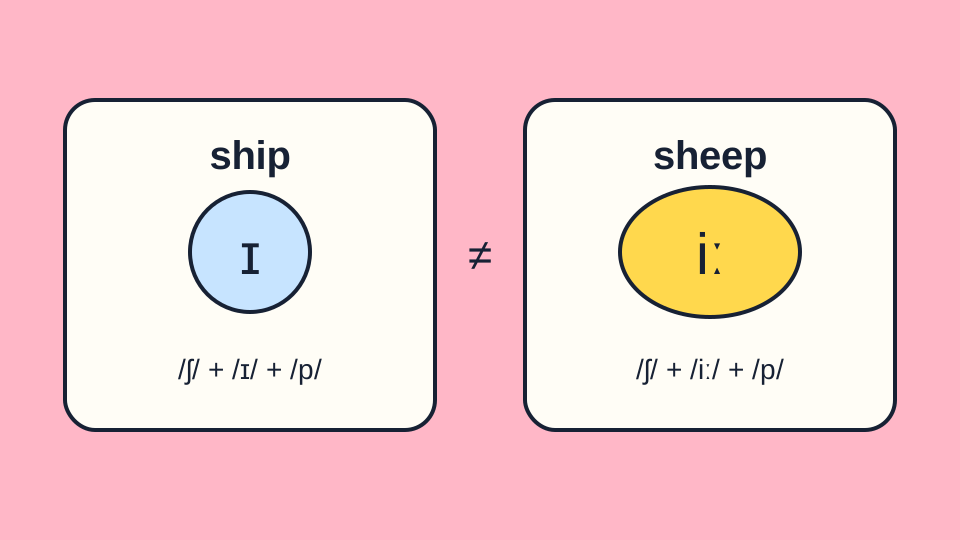
The idea in a minute
A minimal pair differs by one sound in the same position. Ship and sheep are useful because the consonants stay the same, leaving your attention free for the vowel. The contrast is not simply “short versus long”: vowel quality also matters, and duration changes with context. Aim to recognize the pair before making your own speech faster.
What your mouth is doing
For /iː/, keep the tongue high and toward the front, with lips gently spread. For /ɪ/, let the tongue sit slightly lower and less far forward; the jaw can be a little more relaxed. Keep the opening /ʃ/ and final /p/ steady. Avoid an exaggerated smile or force in the jaw: a small adjustment is enough to explore the contrast.
Connect it to your first language
Learners whose first language has one close front vowel may map both English vowels to it. Spanish /i/ and Mandarin yi can help locate a starting area, but neither explains the whole English contrast. Listen for a change in vowel color and position. At the end, release /p/ without adding “uh”; the word must not grow another syllable.
Try this practice sequence
- Listen to ship and sheep in one accent. Look at the word only after listening. Keep the playback volume comfortable and replay a whole word rather than an isolated fragment.
- Say sheep, then relax the tongue slightly toward ship. Alternate slowly three times. Keep the consonants and speaking volume similar.
- Use the minimal-pair quiz without a timer. After a wrong answer, replay the target and speak both choices deliberately. Do not rush into another random pair.
- Put both words into the sentence below. Then test sit/seat to see whether the contrast transfers to new consonants. Save the pair that still needs work.
Common traps
Length alone can mislead: a vowel before a voiceless consonant can be shorter than the same vowel elsewhere. Do not decide from spelling alone, and do not assume a synthetic voice is a perfect model. If two outputs are unclear, compare dictionary recordings in the same accent. A recognition score cannot tell you whether your own articulation is correct.
Notice the contrast
Make two columns, /ɪ/ and /iː/. Place ship and sit in the first, sheep and seat in the second. Ask a practice partner to choose a word without showing the text, or use the listening quiz. Identify it, then explain which vowel quality led you to that choice.
Take it into words
Relaxed high-front vowel
Higher, farther forward
Transfer the same contrast
The sheep is on the ship.Pronounce ↗Pronunciation learning FAQ
Should I practise many pairs at once?
Start with one contrast in several words. Add another only when you can hear the first in a shuffled order and use it in a sentence.
Sources & scope
PronounceKit provides original explanations and schematic illustrations, with linked pronunciation references. Broad IPA describes selected common US/UK forms, not every accent. Synthesized voices and quiz scores are practice aids. These guides have not been independently validated by a pronunciation specialist; send corrections through Contact.
Contact