Foundations
Read IPA without memorizing a wall of symbols
Learn to read a word in broad IPA: find its stress, separate sounds from letters, and use a small set of symbols in real practice.
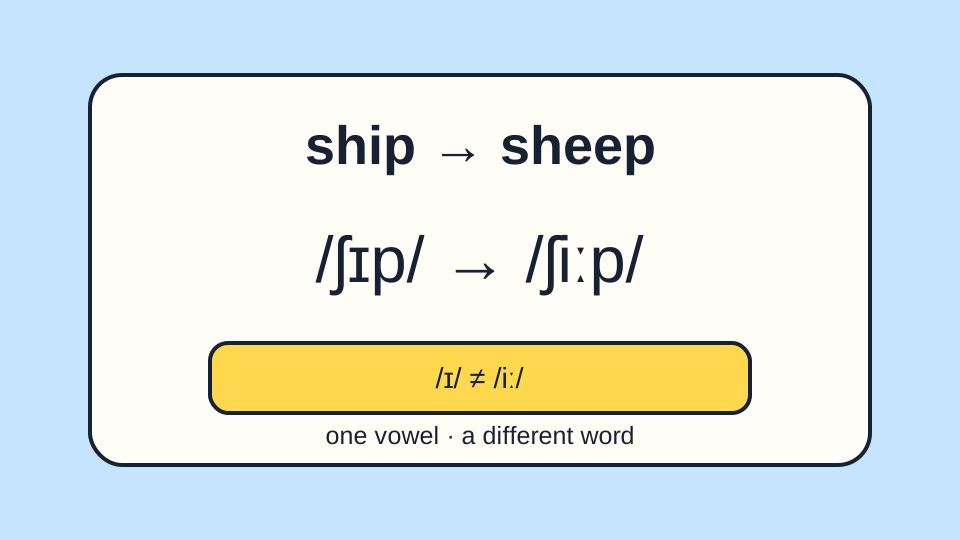
The idea in a minute
IPA is a map from symbols to sounds, not a second spelling test. Start with a word you already know, such as ship /ʃɪp/. Its four letters represent three sounds. Learn those three symbols, then compare sheep /ʃiːp/: only the middle sound changes. A small contrast gives each symbol a purpose.
What your mouth is doing
For /ʃ/, bring the front of the tongue near the roof of the mouth behind the tooth ridge and let air hiss through a gap. For /ɪ/, keep the tongue high but relaxed; for /iː/, bring it a little higher and farther forward. Close both lips for /p/, then release. Symbols become useful when you connect them to a movement and a sound.
Connect it to your first language
English spelling encourages guesses such as reading ee as two separate vowels. Mandarin pinyin and Spanish spelling offer useful starting points, but neither distinguishes every English vowel. If Spanish /i/ or Mandarin yi is your reference, listen for how ship differs from it; do not merely shorten your usual vowel. Do not add a vowel after final /p/.
Try this practice sequence
- Look up ship in a pronunciation dictionary. Pick one accent and listen before reading the transcription. Notice the beginning, middle and ending separately.
- Read /ʃɪp/ from left to right. Treat /ʃ/ as one sound. Then compare /ʃiːp/ and identify the changed symbol with your finger.
- Try about /əˈbaʊt/. The mark ˈ introduces the stressed syllable, not the previous one. Clap on bout, then say the whole word smoothly.
- Save two words and their difficult sound in your notebook. The next day, predict the sound from IPA before playing the voice. Check the dictionary if the synthesis is unclear.
Common traps
Do not mix a letter name with a sound: the letter i is not always /aɪ/. Slashes / / normally enclose broad phonemes; square brackets [ ] can show finer detail. Dictionaries may use /e/ or /ɛ/ for the DRESS vowel, and /r/ or /ɹ/ by convention. Read the dictionary key instead of assuming that a different symbol always means a different word.
Notice the contrast
Cover the spelling of ship and sheep. Read each transcription, point to the middle vowel, then uncover the words. Reverse the task: look at a word and choose its transcription. If you only remember the order, shuffle the pair before trying again.
Take it into words
Three sounds, four letters
Change the middle vowel
Stress follows ˈ
A sheep is on the ship.Pronounce ↗Pronunciation learning FAQ
Do I need every IPA symbol first?
No. Learn symbols inside a small word set and expand when you meet a new contrast. Use the full chart as a reference, not a memory test.
Sources & scope
PronounceKit provides original explanations and schematic illustrations, with linked pronunciation references. Broad IPA describes selected common US/UK forms, not every accent. Synthesized voices and quiz scores are practice aids. These guides have not been independently validated by a pronunciation specialist; send corrections through Contact.
Contact