Everyday rhythm
Schwa: make room for the important syllable
Find the relaxed /ə/ vowel in unstressed syllables and practise word rhythm without swallowing sounds.
The idea in a minute
Schwa /ə/ is a common vowel in unstressed English syllables. It is not the name of a letter, and different written vowels can represent it. In about /əˈbaʊt/, the first syllable is light while bout carries the stress. Learning schwa helps you give a word shape without making every syllable equally strong.
What your mouth is doing
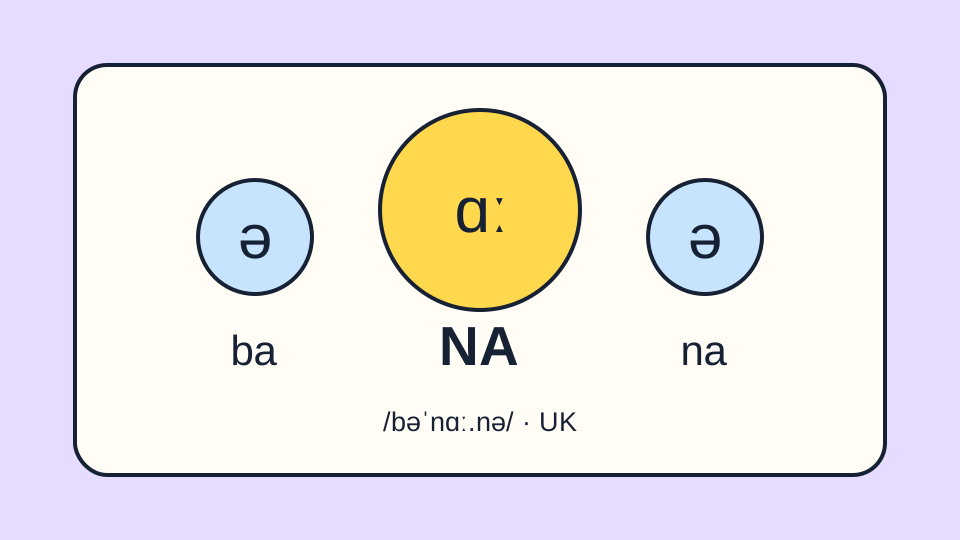
Let the jaw and tongue rest in a comfortable central position, with unrounded lips and gentle voiced airflow. Keep the vowel brief and connected to its neighbors. Do not force one precise frozen mouth shape: the surrounding consonants and speaking context affect the realization. The diagram below represents prominence, not an exact vowel measurement.
Connect it to your first language
Mandarin unstressed syllables offer an intuition for reduced prominence, but they are not automatically English /ə/. Spanish usually preserves clearer vowels in unstressed syllables, so you may need to allow more centralization in English. Keep the word intelligible; reduction is not permission to drop every quiet vowel.
Try this practice sequence
- Listen to about and sofa. Find the stressed syllable first, then look for /ə/ in the quieter syllable. Do not start by searching for a particular letter.
- Say bout, then attach a light /ə/ before it to build about. Keep the final /t/ and avoid a long pause between the syllables.
- Use a common British banana /bəˈnɑː.nə/. Let the middle syllable be clear and the outer syllables lighter. American forms commonly have /æ/ in the stressed syllable.
- Say the complete sentence below twice: once slowly to locate the weak vowels, then at a comfortable conversational pace. Save the sentence rather than only the vowel symbol.
Common traps
Not every unstressed vowel is schwa: happy often ends in /i/. Do not confuse /ə/ with stressed /ʌ/ in cup. They may be near each other in the vowel space but have different roles in these words. Do not over-reduce a word when it is contrastively emphasized; speech changes with what you mean.
Notice the contrast
Compare the first syllable in about with the full stressed vowel in cup /kʌp/. Then compare sofa /ˈsəʊ.fə/ (UK) with its written final a: listen to the actual weak vowel instead of borrowing the letter name. These are targeted comparisons, not minimal pairs.
Take it into words
Light beginning
Light ending
Light–strong–light
A banana is on the sofa.Pronounce ↗Pronunciation learning FAQ
Does schwa mean speaking carelessly?
No. It is a normal part of many English pronunciation patterns. Use it where the word and context support it, while retaining meaningful contrasts and clear stress.
Sources & scope
PronounceKit provides original explanations and schematic illustrations, with linked pronunciation references. Broad IPA describes selected common US/UK forms, not every accent. Synthesized voices and quiz scores are practice aids. These guides have not been independently validated by a pronunciation specialist; send corrections through Contact.
Contact