From words to sentences
Connect words without racing through them
Practise consonant-to-vowel linking, meaningful phrase groups and a short routine for clear connected speech.
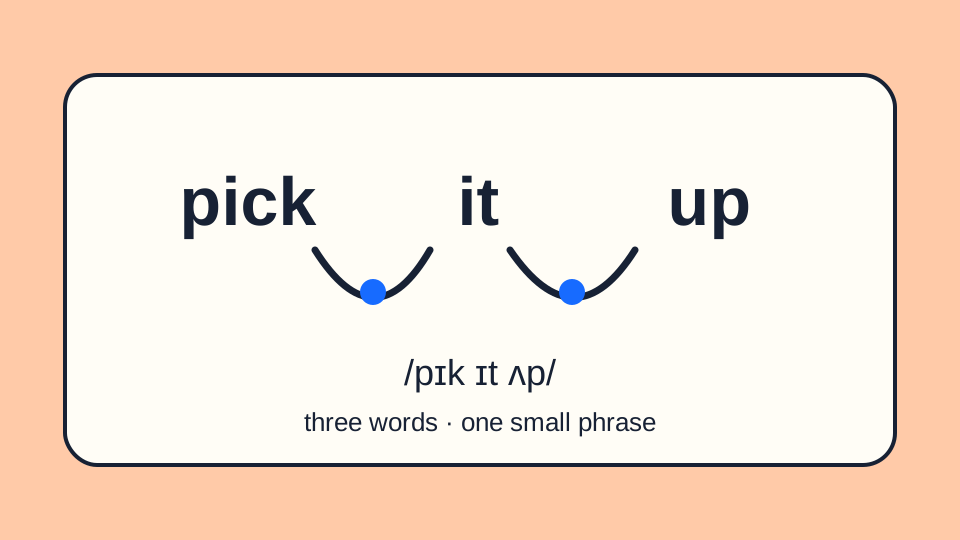
The idea in a minute
Connected speech describes how neighboring words influence one another in a phrase. Linking is one useful starting point: in pick it up, the final consonant of one word meets the next vowel without a full stop between them. It does not require speaking quickly. Good grouping gives the listener clear units of meaning and sensible places to pause.
What your mouth is doing
For pick it, release the /k/ directly into the next vowel. For it up, move from /t/ into /ʌ/ without inserting a new neutral vowel. Keep your breath steady across the small phrase, then pause at a meaningful boundary. This is coordination, not deleting all final consonants. More detailed changes vary with accent, speed and emphasis.
Connect it to your first language
Mandarin speakers may insert a vowel after final stops or separate every written word. Practise carrying the final consonant into the next vowel instead. Spanish speakers already link across word boundaries, which is useful, but English stress and vowel reduction need separate attention. Transfer continuity, not every Spanish vowel pattern.
Try this practice sequence
- Read the sentence once for meaning. Mark a slash at one natural pause: “Pick it up / and put it away.” Do not place a slash after every written word.
- Build backward: up, it up, pick it up. Keep the vowel at the end as your destination while adding the previous consonant.
- Repeat the first group slowly, then the second. Keep the main content words clear. Only join the two groups after each feels comfortable.
- Try a new sentence from your daily life. Mark its phrase boundary and one consonant-to-vowel link in a notebook note. Play and repeat the whole sentence at a comfortable speed.
Common traps
Avoid racing, deleting endings indiscriminately or adding an extra vowel to bridge a difficult cluster. Elision and assimilation exist, but they are context-dependent options, not commands to make speech less clear. A synthetic voice may demonstrate some connections and miss others. Use varied real recordings for listening alongside this practice tool.
Notice the contrast
Say “pick / it / up” with three deliberate pauses, then “pick it up” as one small unit. Keep the same words and overall clarity. Notice that smoother coordination can improve flow even when your total speaking speed barely changes.
Take it into words
/k/ → /ɪ/, /t/ → /ʌ/
/n/ → /æ/
/n/ → /ɪ/, /t/ → /ɒ/
Pick it up and put it away.Pronounce ↗Pronunciation learning FAQ
Must I copy every reduction I hear?
No. Learn to recognize reductions for listening, but prioritize clear stress, meaningful groups and comfortable linking in your own speech. Context and audience matter.
Sources & scope
PronounceKit provides original explanations and schematic illustrations, with linked pronunciation references. Broad IPA describes selected common US/UK forms, not every accent. Synthesized voices and quiz scores are practice aids. These guides have not been independently validated by a pronunciation specialist; send corrections through Contact.
Contact